FAQs
The answers to some of our most commonly asked questions.
Pentland Floating Offshore Wind Farm is being developed by Highland Wind Limited which is majority owned by a fund managed by Copenhagen Infrastructure Partners (CIP) with Hexicon AB as a minority shareholder. Copenhagen Infrastructure Partners P/S (CIP) is a fund management company focused on energy infrastructure including offshore wind, onshore wind, solar photovoltaic (PV), biomass and energy-from-waste, transmission and distribution, reserve capacity and storage, and other energy assets like Power-to-X. It was founded in 2012 and currently has approximately EUR 16 billion under management. CIP is a major investor in the offshore wind sector and has significant investments in a number of offshore wind projects around the world. Development activities are being led by CIP’s development partner, Copenhagen Offshore Partners (COP). The project development team is based in COP’s Global Floating Wind Competence Centre in Edinburgh.
Almost 80% of the world’s wind resource is in water deeper than 60 metres. It is where windspeeds are stronger and more consistent meaning higher capacity factors. Currently the majority of offshore wind farms in Scotland are fixed directly to the seabed, there are only two floating wind farms in operation. Unlike traditional fixed bottom wind farms, floating wind farms use wind turbine generators mounted on a floating substructure which is connected to the seabed using mooring lines and anchors. Much of the seabed around Scotland is too deep to be well suited to fixed bottom turbines. Floating offshore wind provides a technological solution which enables the production of large amounts of renewable energy which will be important to both Scotland's and the UK’s energy transition and is key to achieving net zero.
The Pentland Floating Offshore Wind Farm Project is an update to the Dounreay Trì Project that was granted key consents and a site lease in 2017. The original Dounreay Trì Project consisted of a two-turbine offshore wind farm, with an installed capacity of between 8 to 12 MW, approximately 6 km off Dounreay, Caithness. Highland Wind Limited acquired the Project and associated consent, licences and site lease in 2021. The Pentland Floating Offshore Wind Farm will be built out under a new consent.
The primary objective of the Pentland Floating Offshore Wind Farm is to test and demonstrate a technology solution for floating wind in Scotland. By developing the project in stages, through deploying the single turbine followed by the remaining turbines a year later, the capabilities of the local supply chain in Scotland will be better understood. This understanding will allow us to support the development of a strong local supply chain for floating wind in Scotland, helping to meet climate change targets, and providing highly skilled jobs and energy security. Highland Wind Limited firmly believes that this project will be an enabler for larger scale developments resulting from the current ScotWind Leasing Round and in turn will result in knowledge exchange and export opportunities in relation to the global floating offshore wind market.
In October 2022, it was announced that Stiesdal Offshore’s innovative TetraSub concept, the world’s first fully industrialised floating technology, will be the floating foundation structure for the project. The TetraSub concept is the world’s first fully industrialised floating offshore technology offering a lightweight and cost-effective floating foundation made up of factory-made modules. No manufacturing takes place at the quayside, instead these ready-made modules are assembled in ports using existing infrastructure to form a complete foundation. The process significantly reduces both manufacturing hours and transportation costs and enables assembly to take place domestically within local ports.
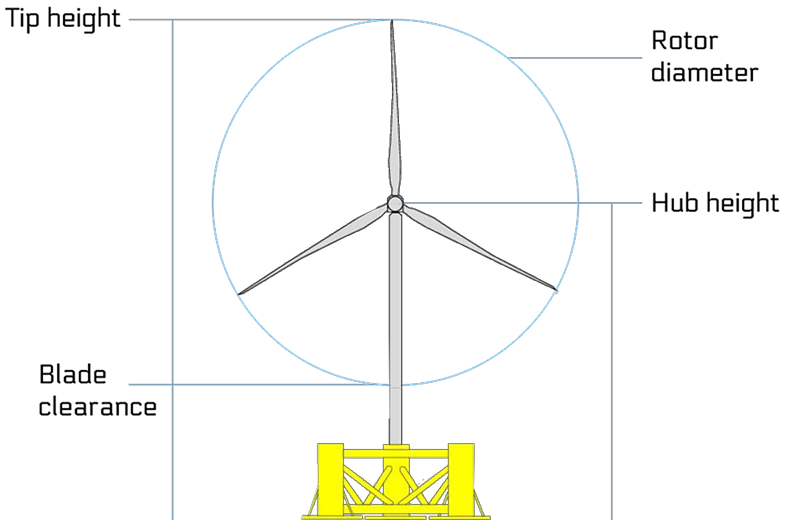
The Pentland Floating Offshore Wind Farm is located off the coast of Dounreay. The visual impact of the turbines has been assessed through the Seascape, Landscape and Visual Impact Assessment which is available in the Document Library.
We are working to engage closely with landowners, local residents, the Maritime Coastguard Authority, ports and harbours and Traffic and Transport Scotland to ensure the development minimises disruptions to local communities as far as possible. We already understand there are some concerns regarding construction and operational traffic in the local area. This has been taken into account in our application.